

Know your feet. Play with confidence.
Pain stops play. Knowledge prevents it. Everything we have learned about foot health, pickleball biomechanics, and keeping yourself on the court for the long run.
Free resource · No sign-up required
Foot fundamentals
Your feet do more work on the pickleball court than you realize
Pickleball requires lateral cuts, hard stops, and rapid direction changes that running, walking, and most gym workouts simply do not replicate. Your plantar fascia, heel pad, and arch absorb force across these movements thousands of times per session. When the load exceeds what the tissue can recover from overnight, pain develops.
Most generic insoles were designed for forward motion. They absorb vertical impact adequately, but they were never tested for the lateral shear forces that define pickleball. Understanding how your feet work during the game is the first step to protecting them.
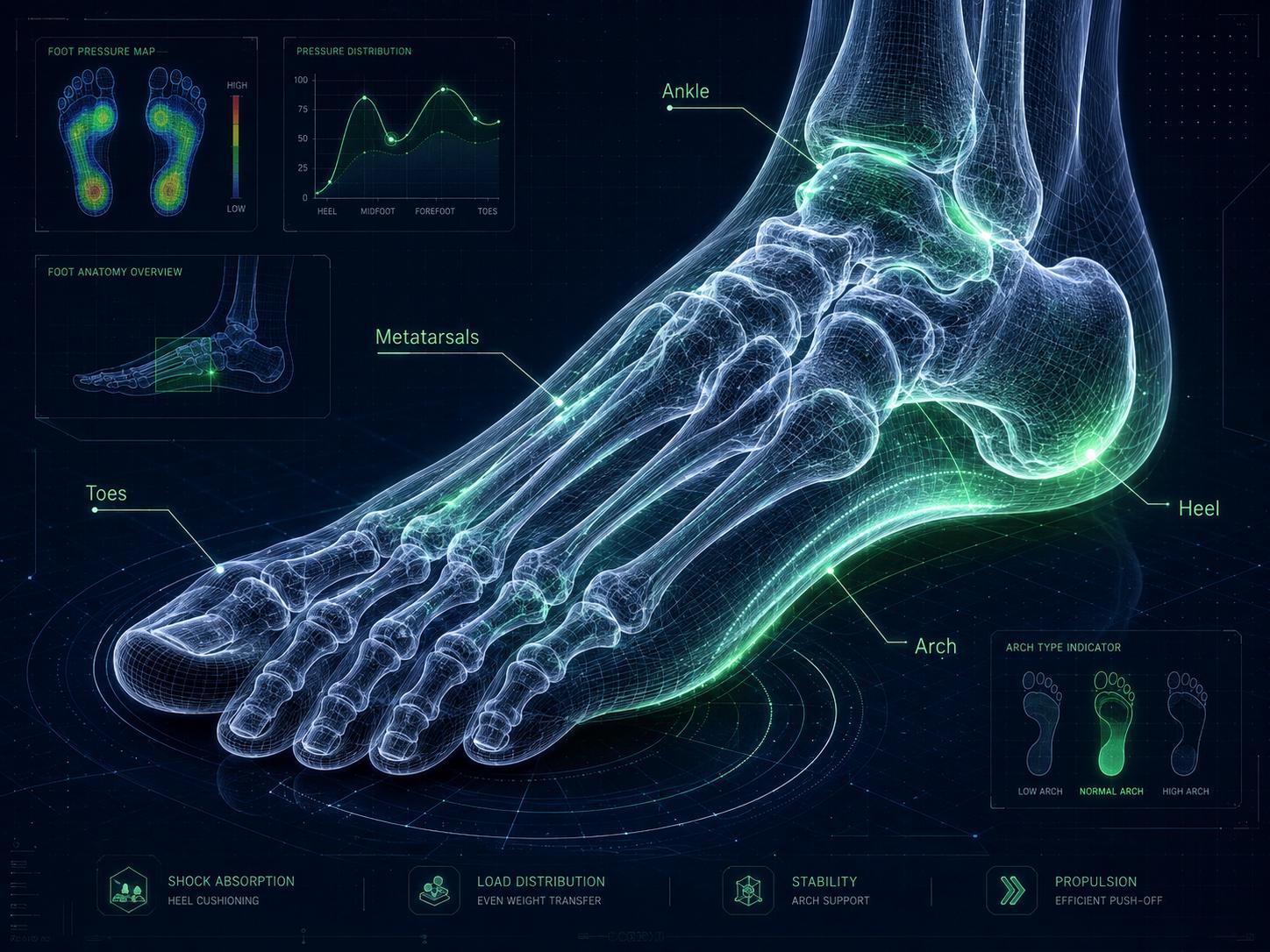 Foot anatomy overview
The pickleball load profile
Why pickleball is uniquely demanding on your feet
Most foot pain research focuses on running. Pickleball is a different sport with different biomechanical demands.
- 01
Lateral shear force
Every split step and side-shuffle generates horizontal force against the inside edge of your foot. Standard insoles offer no lateral resistance, so the plantar fascia absorbs that load directly.
- 02
Repetitive micro-loading
A two-hour session can involve thousands of short explosive movements. Each one is individually minor, but cumulative load on the arch and heel adds up faster than most players expect.
- 03
Hard court surface
Concrete and acrylic courts return almost all impact energy back to the foot. Court shoes help, but they were designed with forward motion in mind. Lateral loading is largely unaddressed.
Condition library
Understand what you are dealing with
Each condition page includes a plain-language explanation, what causes it in pickleball players, and what you can do about it.
Quick answers
Common questions, direct answers
- What causes plantar fasciitis in pickleball players?
- Plantar fasciitis is inflammation at the point where the plantar fascia attaches to the heel bone. In pickleball players, the combination of hard surfaces, lateral loading, and high session frequency stresses this tissue beyond its recovery rate. The result is micro-tearing and inflammation that shows up as sharp heel pain, particularly in the first steps of the morning.
- Do insoles actually help with heel pain?
- Clinical guidelines support foot orthoses as part of a multi-modal treatment approach to heel pain. They do not heal the plantar fascia directly, but they reduce peak load at the attachment site, giving the tissue a better chance to recover between sessions. The key is a design that addresses the specific loading pattern, not just general cushioning.
- How long does it take to see results from an insole?
- Most users notice comfort improvement within the first few sessions, as the fit and cushioning changes are immediate. For injury recovery, meaningful load reduction takes two to four weeks of consistent use to translate into reduced inflammation. Every HeelBase insole has zero break-in time.
- What is the difference between plantar fasciitis and a heel spur?
- Plantar fasciitis is inflammation of the plantar fascia ligament. A heel spur is a bony growth that can form where the plantar fascia attaches to the heel bone, sometimes as a result of long-standing plantar fasciitis. The two conditions can coexist, but heel spurs do not always cause pain. Treatment for both focuses on load reduction and tissue support.
- Should I rest completely or keep playing with heel pain?
- Complete rest is rarely necessary and often counterproductive for plantar fasciitis. Load management is more effective: reducing session frequency or duration while maintaining activity, combined with targeted support, gives the tissue time to recover without deconditioned weakening. If pain is severe or worsening, consult a physical therapist.
Find out what your feetactually need.
Take the free 2-minute assessment and get a personalized recovery direction, or go straight to the insole built for pickleball.
Free assessment. 30-day money-back guarantee.