Insoles range from bargain foam at the pharmacy to custom orthotics that cost many times more. In between sit the structured and court-specific insoles most pickleball players end up choosing from, and the price gap between them is what stops a lot of people at the checkout.
Expensive insoles are worth it for pickleball when you play often, have recurring heel or arch pain, or need a fit cheap inserts can't give you. If you play once a week, feel fine, or only want extra cushioning, a cheaper insole is often the right call. Judge cost per session, not the price tag.
We make court insoles, so we have an obvious interest in the answer. That's why this article spends as much time on when not to spend as on when to. Below, we break down what the money buys at each level, where the returns level off, and how to run the cost-per-session math for your own game.
Key Takeaways
- The biggest jump in value comes from moving from soft foam to a firm arch and heel cup, not from the priciest models.
- Price buys durability, fit options and court-specific design, but not comfort, which depends on your foot and your shoe.
- Compare cost per session: the price divided by the number of sessions the support actually lasts for you.
- Playing three or more times a week favors durable structure, because soft foam flattens fastest under heavy use.
- If you play once a week, feel fine, or just want cushioning, a cheaper insole is often the right choice.
- Custom orthotics rarely pay off for recreational players unless a diagnosis calls for them.
- If your court shoes are worn out, spend on shoes first, because no insole can rebuild a collapsed midsole.
What Does More Money Actually Buy in an Insole?
Insole prices climb in rough steps, and each step pays for something different. Here's what you get at each level, from the liner already in your shoe to a device made by a clinician:
| Level | What the money buys | Where it falls short | Often right for |
|---|---|---|---|
| The factory liner | Nothing extra; it came with the shoe | Thin foam with little arch or heel structure | Pain-free players in shoes that fit well |
| Drugstore foam and gel inserts | Extra cushioning and a softer feel | Little structure, and soft foam compresses quickly | Light play, or testing whether you like more underfoot |
| Structured over-the-counter insoles | A firm arch shell and heel cup that hold their shape | Generic shapes, usually trimmed to fit | Recurring arch or heel aches, regular play |
| Court-specific insoles | Design for lateral movement, deeper heel cups, more fit options | Higher price, with returns that depend on how much you play | Frequent play, unsteady ankles, tricky fit |
| Custom orthotics | A device shaped to your foot after a clinical assessment | Highest cost, plus appointments and adjustment time | Diagnosed conditions or feet that stock shapes don't fit |
The biggest jump in value happens early, between the second and third rows. Going from soft foam to a firm arch and a heel cup that holds its shape changes what your foot actually stands on. Past that point, extra money buys refinements: a closer fit, design aimed at lateral movement, lighter materials and longer-lasting structure. Those refinements pay off in proportion to how much you play.
Start with what you already own. Most factory liners are thin, flat foam with little heel or arch structure, and a new insole usually replaces the liner instead of sitting on top of it. It helps to know whether to remove factory insoles before you compare prices, since doubling up changes how any pair fits.
Recovery assessment
Match your support to the way you play
The 2-minute HeelBase assessment considers your symptoms, playing frequency, and foot history to help narrow down the right insole.
Take the assessmentWhat Can't a Higher Price Buy?
Price tracks materials, construction and fit options. It doesn't track how an insole feels on your foot. When researchers compared running shoes at three price points from three brands, the low- and mid-priced pairs cushioned as well as the most expensive ones, if not better, and comfort ratings bore no relation to price.
That study looked at shoes rather than insoles, but the lesson carries over. A higher price is no guarantee of a better feel underfoot, and four things stay out of reach whatever you spend:
- Comfort for your foot. Comfort is personal, so the right insole is the one that suits your arch and your shoe.
- The right shape. A well-made insole in the wrong arch profile still behaves like the wrong insole.
- A fix for a worn-out shoe. An insole can't restore a broken-down midsole or a heel counter that no longer holds.
- Protection from injury. No insole at any price prevents sprains or guarantees pain-free play.
The shape point is the one buyers trip over most. It sits at the center of our CURREX PICKLEBALLPRO review, because when an insole comes in High, Medium and Low arch profiles, the one you pick shapes how it feels more than any feature on the box. The same holds for any insole sold in more than one shape.
How Do You Work Out Cost Per Session?
The sticker price tells you what you pay once. Cost per session tells you what each game on proper support costs, and it's the fairer way to compare a cheap insole with an expensive one. Here's how to work it out:
- Count your sessions per week, including drills, lessons and league nights.
- Estimate how many weeks the support lasts for you, meaning the arch and heel cup still feel close to new.
- Multiply the two to get the number of sessions of useful life.
- Divide the price by that number to get your cost per session.
Session counts add up faster than most players expect. This is how many sessions you log at different weekly volumes:
| Sessions per week | Over 3 months | Over 6 months | Over 12 months |
|---|---|---|---|
| 1 | 13 | 26 | 52 |
| 2 | 26 | 52 | 104 |
| 3 | 39 | 78 | 156 |
| 4 | 52 | 104 | 208 |
| 5 | 65 | 130 | 260 |
The math gives you a simple break-even rule. If one pair costs twice as much as another, it needs to keep its support for twice as many sessions to cost the same per game. Say a cheaper pair stays supportive for 40 sessions and a sturdier one for 120. The sturdier pair can cost up to three times as much and still come out even.
Heavy play is where the difference shows. Four sessions a week is more than 200 a year, and soft foam has to absorb every landing. A study of EVA foam running-shoe midsoles found peak pressure under the foot roughly doubled after 500 km of running as the foam fatigued. Pickleball doesn't log kilometers, but the pattern carries over: cushioning fades gradually, so the decline is easy to miss.
That's the hidden cost of a cheap insole. The sessions you play after the support has faded don't show up on a receipt, but you pay for them in tired arches and sore heels. Knowing how long insoles last under court use helps you put a realistic number into step two instead of a hopeful one.
Construction changes the math too, because it decides how long the structure holds. Layers of glued foam can compress and separate, while a firm shell or a single printed piece has fewer ways to break down. Whatever you buy, structure that keeps its shape is what lets a higher price pay back over more sessions.
When Is a Cheaper Insole the Right Call?
Spending less is often the right decision, and you shouldn't let anyone talk you out of it. A cheaper insole makes sense if any of these describe you:
- You play once a week or less, and your feet feel fine afterward.
- You want a softer feel underfoot, not more support.
- You're new to the game and not yet sure how often you'll play.
- You want to test whether anything under your foot helps before committing more.
- Your discomfort is mild and settles within a day.
Cleveland Clinic notes that store-bought inserts work well for minor pain from mild conditions, and suggests choosing one with a firm arch that doesn't easily give. That's the detail to hold onto at the low end. Press the arch with your thumb before you buy, and if it folds flat, expect it to do the same under your foot.
Some players don't need an insole at all. A court shoe that fits well, with its factory liner, can be enough for occasional pain-free play. If you're unsure which group you're in, the signs you need insoles are a quick self-check, from heel pain in your first steps to a factory liner worn visibly thin.
When Does Spending More Pay Off?
The case for a pricier insole builds with volume and with symptoms. Spending more tends to pay back when:
- You play three or more times a week, so durable structure spreads its price over far more sessions.
- Heel or arch pain keeps coming back after you play.
- You've already tried cheaper inserts, and they flattened or didn't help.
- Your ankles feel unsteady on lateral moves, and you need a deeper heel cup and a firmer midfoot.
- Your feet are hard to fit: between sizes, unusually wide, or with an arch that stock shapes miss.
- You play long tournament days, where support has to hold up late into the day.
In each of these, the extra money buys something you'll use: structure that lasts more sessions, a shape that suits your foot, or support designed for court movement instead of straight-line running. To compare court insoles feature by feature, our ranked list of court insoles scores ten products on lateral stability, heel positioning, weight and track record.
What Should You Check Before Paying More?
A higher price should buy features you can see and feel. Before you pay more, run the insole through these checks:
- Arch firmness: press the arch with your thumb. A structured insole flexes slightly and springs back instead of folding flat.
- Heel cup depth: look for a cup that wraps the sides of your heel, not a flat pad with a low rim.
- Sizing method: exact sizes fit out of the box, while trim-to-fit insoles are only as accurate as your cut.
- Thickness: a thick insole can crowd a snug court shoe and lift your heel toward the collar.
- Weight: a few grams barely register in one game, but they add up over a long session.
- Return window: a fair trial period lowers the cost of picking the wrong pair.
If a pricier insole doesn't beat a cheaper one on at least two or three of these, the extra money isn't buying much you'll feel on court. If it does, those are the features that earn back the difference over a season.
Are Custom Orthotics Worth the Money for Pickleball?
Custom orthotics sit at the top of the price range, and the evidence suggests the extra cost often doesn't buy better results. In a randomized trial of 135 people with plantar fasciitis, a prefabricated firm-foam orthosis performed similarly to a custom semirigid one, and both gave only small short-term gains over a sham insole.
Cost analysis points the same way. A Dutch trial found that custom-made insoles weren't cost-effective compared with usual care from a family doctor for plantar heel pain over 26 weeks, and its authors urged caution about prescribing them as a first step.
That doesn't make custom devices pointless. They make sense for diagnosed conditions, unusual foot shapes, or pain that hasn't settled with a good over-the-counter insole and proper footwear. For recreational players, the usual order is shoe first, then a structured insole, then a clinician if neither helps. The trade-offs of insoles versus custom orthotics come down to diagnosis, fit and how long you're willing to wait.
When Shouldn't You Spend Anything on Insoles?
Sometimes the best-value insole is none at all, at least for now. Hold off on buying if:
- Your court shoes are worn out, with a midsole that has gone flat or a heel counter that has gone soft.
- Your pain followed a fall or a rolled ankle, or you can't put full weight on the foot.
- You have diabetes, poor circulation or numbness in your feet.
- You're pain-free and play occasionally in shoes that fit.
The first one is the most common. A player buys a premium insole, drops it into a shoe whose midsole has already broken down, then blames the insole when their feet still ache. Look for the signs of worn-out court shoes before you spend on what goes inside them.
The middle two need a clinician before any purchase. A podiatrist can tell you whether you need an insole, a custom device or something else entirely, which saves you paying for the wrong fix at any price.
Product spotlight
Printed, not molded
Most insoles are pressed from stacked foam that packs flat over time. Drive is 3D-printed as one continuous structure, so the support you feel in month 3 matches what you felt on day 1.
Shop DriveHow Much Should You Spend on Insoles?
Put it together and the right spend depends on your volume and your symptoms more than your budget. Use this as a starting point:
| Your situation | Sensible spend | Why |
|---|---|---|
| Pain-free, once a week or less | Factory liner or an inexpensive insert | Few sessions to spread a cost over, and no problem to solve |
| Want more cushioning, no pain | An inexpensive insert with a firm arch | Comfort is the goal, and a modest pair can deliver it |
| Regular play, occasional arch or heel aches | A structured over-the-counter or court insole | A firm arch and heel cup address the most likely cause |
| Three or more sessions a week | A durable court insole | A high session count lowers cost per session and wears out soft foam |
| Unsteady ankles or sliding in the shoe | A court insole with a deep heel cup and firm structure | These features are rare at the low end |
| Diagnosed condition or worsening pain | A clinician's advice first | The right device depends on the diagnosis |
If you land between two rows, start with the cheaper option and step up only if it flattens or doesn't help. Trying a modest pair first costs little, and it tells you a lot about what your feet actually need.
Which HeelBase Insole Should You Get?
If a structured court insole is the right spend for you, here's how our three insoles map to the way you play. We don't treat either court model as the upgrade, so pick by how your sessions actually run, not by price.
Drive: regular court play
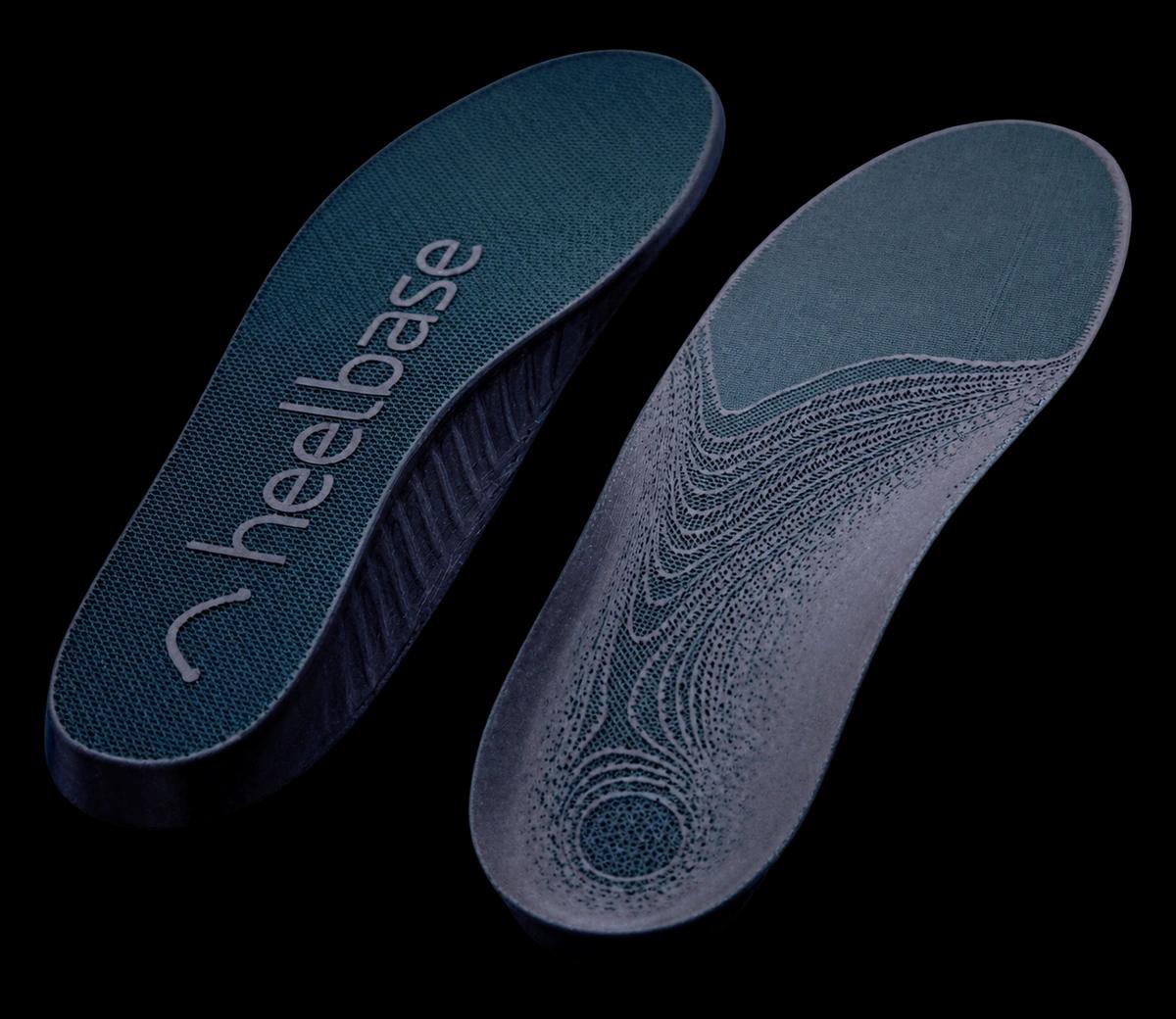
Our Drive court insole suits players who are on court a few times a week and want support that lands in the same place every session. It's a single printed piece of polyurethane with no stacked foams or glue lines, made in nine exact sizes and never trimmed, so the heel cup and arch sit where they were designed to for your size.
At 54.9g, with an open lattice that moves air with every step, Drive is built for long open-play sessions in court shoes that trap heat.
Apex: tournament days and heavy weekly volume
Apex is the structured one. Its 14mm heel cup is the deepest on court, a TPU arch shell braces the midfoot at three points so the arch holds its shape on lateral cuts, and PORON pads at the heel and forefoot absorb repeated impact. It's heavier than Drive, and that's the trade for the structure. It suits players whose hardest sessions run long or come back to back.
Stance: the hours off the court
Stance isn't a court insole. It's built for work shifts, errands and the standing hours between sessions, with a 15mm heel cup, the deepest we make, and a TPU torsion bar under the arch. If your soreness builds at work more than on court, support in your everyday shoes may be the better first spend. It trims to fit casual, work and athletic shoes.
All three come with a 30-day money-back guarantee, counted from delivery, so you can judge one over real sessions before you commit to it.
HeelBase insoles
Find the support your game demands
Browse insoles built around pickleball movement and choose the setup that fits your playing volume, intensity, and time between matches.
Shop insolesFrequently Asked Questions
Are expensive insoles worth it?
Expensive insoles are worth it when you play often, keep getting heel or arch pain, or need a fit that cheaper inserts can't provide. For occasional, pain-free players, a cheaper insole or the factory liner is often enough. Compare cost per session rather than sticker price, because a durable insole spread over many sessions can cost less per game than a cheap one you keep replacing.
Are cheap insoles bad for your feet?
Cheap insoles aren't bad for your feet if they fit and feel comfortable. Their main limits are soft foam that compresses quickly and little arch or heel structure, which is fine for light play or extra cushioning. If a cheap insole flattens within weeks, or your arch or heel starts to ache, move to a firmer, structured design.
How much should I spend on insoles for pickleball?
Spend according to how often you play and whether anything hurts, not to a set budget. Occasional, pain-free players can stay at the low end. Regular players with recurring aches usually get more from a structured insole, and frequent players benefit most from a durable court design. Custom orthotics are best saved for problems a clinician has diagnosed.
Do pricier insoles hold their support longer?
Often, but not always. Firm shells and denser or printed structures tend to hold their shape longer than soft single-layer foam, which compresses with every landing. Price alone isn't proof, though. Press the arch before you buy, and track how the support feels over your first few weeks of play.
Should I spend more on court shoes or insoles?
Fix the shoe first if it's worn out or doesn't fit, because an insole can't make up for a midsole that's packed flat or a loose heel counter. If your shoes are in good shape and still leave you sore, an insole is usually the cheaper fix. Many players replace the factory liner long before the shoe itself needs replacing.
Are drugstore insoles good enough for pickleball?
Drugstore insoles can be good enough for occasional, pain-free play, especially if you mainly want cushioning. They're less suited to frequent play and lateral movement, because most are soft foam with shallow heel cups. If you buy one, choose a firm arch that doesn't fold under thumb pressure, and replace it once it flattens.
Can a good insole make up for cheap court shoes?
A good insole can improve a budget court shoe that fits well and still has a firm midsole and heel counter. It can't make up for a shoe that's the wrong size, too soft through the sides, or already broken down. Buy a shoe that fits and holds your foot first, then add support inside it.
Pay for Sessions, Not Sticker Prices
An expensive insole pays off when it gives you more sessions on good support than a cheaper one would, or when it solves a fit or support problem a cheap insert can't. If neither applies to you, buy the modest pair and spend the difference on court time.
If you're not sure where you land, the HeelBase assessment takes about two minutes and matches your symptoms and playing volume to a recommendation, so you spend on the support your game actually needs.