CURREX and PowerStep come at foot support from opposite directions. CURREX grew out of sports, and its PICKLEBALLPRO is built for the court. PowerStep grew out of the podiatry world, and its insoles are built around a firm shell designed to steady the foot. Both sell well to pickleball players, for different reasons.
For most pickleball players, CURREX PICKLEBALLPRO is the closer fit, because CURREX built it for pickleball, with an anti-slip grip layer, a decoupled heel and three arch profiles. PowerStep PULSE Performance suits players who want a firm polypropylene shell in exact sizes with no trimming, though PowerStep designed it for running.
Below, we compare the two on what each maker publishes: how the arch works, arch choice, grip, sizing, fit in a court shoe, break-in and lifespan. Then we match each one to the players it suits best.
Key Takeaways
- CURREX designed PICKLEBALLPRO for pickleball; PowerStep designed PULSE Performance for running and athletic walking.
- CURREX uses an arch that flexes under load; PowerStep uses a firm but flexible polypropylene shell.
- CURREX offers three arch profiles in one model; PowerStep spreads arch options across separate models.
- CURREX adds an anti-slip grip layer and a decoupled heel aimed at lateral movement.
- PowerStep sells exact sizes with no trimming; CURREX sells letter sizes that you trim to fit.
- Both fit shoe widths up to 2E, and PowerStep makes a separate wide model.
- Pick by your priority: court-specific design, or a firm shell with no trimming.
How Do CURREX and PowerStep Differ?
The biggest difference is how each brand thinks about support. CURREX calls its approach Dynamic Arch Technology, which it says adapts to your arch and moves with you. Its FAQ explains that the arch cradle flattens when your full weight comes onto it, so your foot muscles keep working. The idea is support that gives a little rather than holding the foot rigidly in place.
PowerStep takes a more traditional route. Its PULSE Performance is built on a firm but flexible polypropylene shell with a contoured neutral arch and a deep heel cradle, and PowerStep says the design stabilizes and aligns the feet, adding motion control. The shell is the core of the product, with cushioning layered on top of it.
Neither approach is wrong. They suit different feet and different preferences, and the rest of this comparison is about matching those differences to how you play. If you'd like the full picture on CURREX first, our CURREX PICKLEBALLPRO review looks closely at the grip layer, the profiles and the friction points.
CURREX vs PowerStep at a Glance
Here's how the PICKLEBALLPRO and the PULSE Performance line up on the details each maker publishes.
| Feature | CURREX PICKLEBALLPRO | PowerStep PULSE Performance |
|---|---|---|
| Designed for | Pickleball, padel, paddleball, racquetball, squash | Running and athletic walking |
| Arch approach | Dynamic arch that flexes under load | Firm but flexible polypropylene shell |
| Arch options | High, Medium, Low in one model | Neutral; Low and High in the Pinnacle family |
| Heel | Fully decoupled heel | Deep heel cradle |
| Top layer | Anti-slip Super Grip, mesh | Odor control polyester fabric |
| Cushioning | Dual-layer, targeted forefoot | ShockAbsorb foam over EVA |
| Sizing | Six letter sizes, trim to fit | 11 sizes, no trimming |
| Widths | Up to 2E | Up to 2E; Pinnacle Wide Fit 3E to 6E |
Recovery assessment
Not sure which kind of support you need?
Tell us where you feel discomfort and how often you play. The HeelBase assessment will guide you toward the most relevant support option.
Start the assessmentWhich Has Better Arch Support, CURREX or PowerStep?
On court, the arch has to handle quick loading and unloading. You land from a split step, push off sideways and stop hard, often within a second. A flexing arch and a firm shell respond to that in different ways.
CURREX's arch is designed to give as your weight arrives and spring back as it leaves, which can feel more natural to players who dislike a hard arch. PowerStep's shell is designed to hold its shape, which can feel more supportive to players whose arches drop noticeably under load. Feel is personal, and plenty of players prefer one after years in the other.
Research on stiffness backs the idea that the difference is real, if modest. In a study of single-leg landings, arch pads of different stiffness changed how the ankle and knee moved, but none of them changed the peak force through the ground. A firmer or softer arch changes how the leg shares the load more than how much load there is.
What any arch support does reliably is move pressure around. A 2026 review of orthoses for flexible flat feet found the most defensible effect was mechanical: load shifted from the heel and outer forefoot toward the inner midfoot. Evidence for pain and balance was very low certainty. So judge either brand by whether the arch contacts your foot comfortably, not by promises about pain.
Which Offers More Arch Options?
CURREX builds every model in three arch profiles, High, Medium and Low, and offers an at-home fitting guide to help you choose. If you fall between two profiles, its FAQ recommends picking the lower one. The choice is part of the purchase, so you get a court insole and an arch height in the same box.
PowerStep handles arch choice differently. PULSE Performance has a single neutral arch. For other arch types, PowerStep sells separate models, mostly in its Pinnacle family: Pinnacle Low for flat feet, Pinnacle High for high arches, and Maxx versions with a 2 degree medial post for feet that roll inward. Those are aimed at everyday and work shoes rather than at court play.
That gives CURREX the edge for players who need a low or high arch in a court-focused insole. It also means CURREX asks you to choose well. Its fitting guide combines a wet footprint test with a knee alignment check, and our CURREX and Superfeet comparison explains how the two results combine into a profile.
Arch height isn't a precise science either way. In a study of 19 runners, different arch support heights, from none to 40mm, had no systematic effect on rearfoot motion or shin rotation. Choose the height that feels right under your arch, rather than chasing the one that claims to correct you.
What Do CURREX's Grip Layer and Decoupled Heel Do?
Two CURREX features have no direct match on the PowerStep side. The first is the Super Grip top layer, which CURREX describes as an anti-slip surface for secure lateral movement. The aim is to stop your foot sliding across the insole when you stop or change direction.
The second is a fully decoupled heel. CURREX separates the heel section from the rest of the insole, and says the design allows natural, efficient movement. PowerStep's deep heel cradle takes the opposite approach, holding the heel in a cupped shell.
Grip comes with one caution. A surface that holds your foot also creates more friction between skin, sock and insole, and friction is what drives blisters. Wear moisture-wicking socks, and break the insole in before a long day. If you're prone to hot spots, the habits in preventing blisters in pickleball matter more with a grippy insole.
How Does Sizing Compare?
This is the most practical difference. CURREX sells PICKLEBALLPRO in six letter sizes, from XS to 2XL, each covering a range such as Men's 7 to 8.5. Most players then trim the toe end to their shoe's outline. PowerStep sells PULSE Performance in 11 sizes, each covering a half-size pair such as Men's 8 to 8.5, and says no trimming is required.
Each model has its strengths. Trim-to-fit handles awkward sizes and odd shoe shapes, because you cut the insole to your own liner. Exact sizes save you the cut and let one pair move between shoes of the same size. The tradeoffs of trim-to-fit and true size come down mostly to how many pairs of shoes you plan to use.
The size bands don't line up exactly, either. A men's 9 sits at the bottom of CURREX's LG band, which runs to 10.5, so that player trims more length off. In PowerStep's chart, the same player takes size F, which covers Men's 9 to 9.5, and fits it as supplied. Check both charts against your measured foot length, not the size printed in your last pair of shoes.
If you choose CURREX, trim carefully, because a cut can't be undone. Use your shoe's factory liner as the outline, take off a little at a time, and check the fit after each cut. A careful insole trimming method avoids the most common mistake, which is cutting too short.
Which Fits Better in a Court Shoe?
Both brands are designed to replace your shoe's factory liner, not sit on top of it. CURREX says its insoles have the same 4 mm height as standard insoles. PowerStep doesn't publish a thickness for PULSE Performance, but offers PULSE Thin for tight-fitting shoes.
Height isn't the same as volume, though. An arch and a heel cup take up room that a thickness figure doesn't capture. In a snug court shoe, try the insole with your court socks before you trim anything or commit to a long session, and check for pressure across the top of your foot and at your toes.
Both brands list shoe widths up to 2E for these models. For wider feet, PowerStep makes Pinnacle Wide Fit for widths from 3E to 6E. CURREX doesn't list a wider version of PICKLEBALLPRO.
Product spotlight
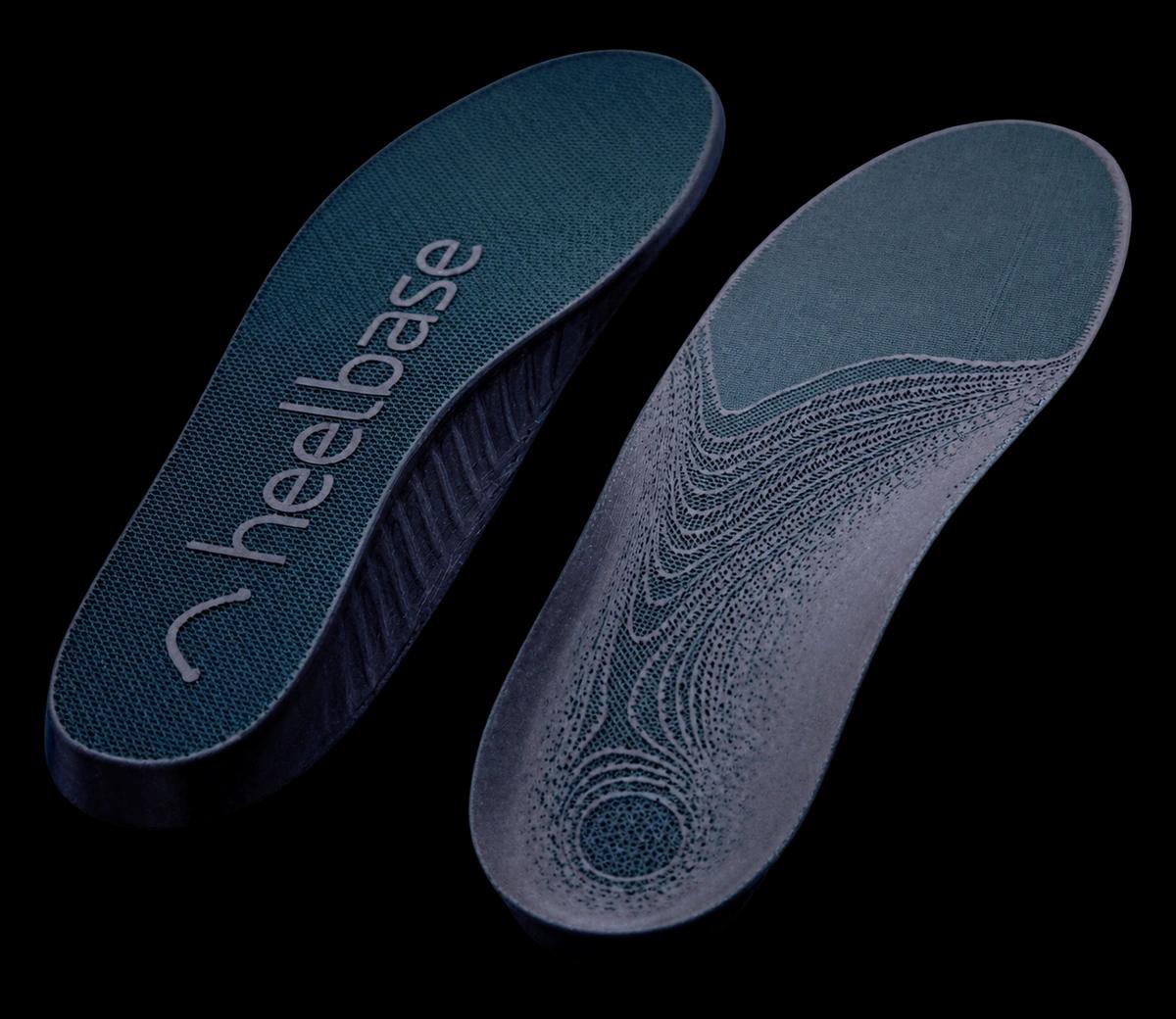
The first 3D-printed insole for the court
Drive is printed as one continuous piece, engineered to the millimeter, with no glue lines and no bonded foams to separate. An 11.3mm printed heel pocket and shaped arch shell keep load off your plantar fascia through long sessions.
Shop DriveHow Long Do CURREX and PowerStep Insoles Last?
CURREX says most people adapt quickly, but recommends wearing its insoles for one or two days before using them for sport. PowerStep's firm shell can also take a few sessions to feel normal. With either brand, try drills or casual games before a league night or tournament.
The lifespan guidance differs in format. CURREX gives a distance and a time limit, about 500 miles or 12 months in its FAQ, whichever arrives first. PowerStep's guidance is six months or more, with wear, usage and activity level deciding where in that range a pair ends up.
For court players, the condition of the insole is the better guide: a worn top layer, a flattened heel, or the return of the discomfort you bought them to fix.
On returns, CURREX's FAQ allows returns within 60 days of purchase for a full refund on its own site. Policies vary by retailer for both brands, so check before you buy.
Are Either Worth It Over Your Factory Liner?
Most court shoes ship with a thin foam liner that adds comfort but very little structure. It rarely has a shaped arch, and the heel area is usually flat. Both CURREX and PowerStep replace that liner with something more deliberate: a contoured arch, a cupped or decoupled heel, and a cushioning layer designed for repeated impact.
Whether that upgrade is worth it depends on your feet. If your feet feel fine after long sessions, the factory liner may be all you need. If you finish with sore arches, aching heels or a foot that slides around in the shoe, a structured insole is a sensible next step, and both brands are reasonable places to start.
Price alone won't tell you which insole will work, and our look at the value of premium insoles goes further into what extra spend actually buys.
Which Is Better for Pickleball?
CURREX PICKLEBALLPRO is the better match for most court players. It's the only one of the two built for pickleball, it offers three arch profiles in a single court model, and its grip layer and decoupled heel target the lateral movement the sport demands.
CURREX is the stronger pick if any of these sound like you:
- Your foot slides inside the shoe when you stop or change direction.
- You want a low or high arch in an insole designed for the court.
- A hard arch has felt uncomfortable in the past.
- You also play padel, racquetball or squash, which CURREX lists among its uses.
PowerStep is the better choice in a few situations:
- You prefer a firm shell that holds its shape under load.
- You don't want to trim an insole, or you want one pair to move between shoes.
- You need a width beyond 2E, where Pinnacle Wide Fit takes over.
- You want a posted shell for feet that roll inward, which the Maxx versions provide.
- You also want matching support in work or walking shoes from the same brand.
If neither feels right, the wider field is worth a look. Our roundup of the best CURREX alternatives compares other options, from fixed-shape shells to court-specific builds.
How Do You Choose Between Them on Court?
If you can try both, a short side-by-side test tells you more than any spec sheet. Put one brand in each shoe, or try them on different days, and run through the same routine:
- Stand at your ready position and notice where you feel the arch, and whether it presses or simply contacts your foot.
- Do a few split steps and land softly. Notice whether the arch gives or holds.
- Shuffle sideways at speed and stop hard. Check whether your foot slides on the insole.
- Lunge wide to each side and feel whether your heel stays seated.
- Play a short session, then check for hot spots, rubbing or arch pressure.
The insole that disappears under your foot during play is usually the right one. If one brand feels supportive standing still but noisy during movement, trust the movement.
Give each insole a fair trial before you decide. A first session mostly tells you how different the insole feels from your old liner, which isn't the same as how well it works. Two or three sessions, ideally including one long one, show whether the arch settles in, whether the grip or shell suits your footwork, and whether any pressure point fades or builds.
What About CURREX vs PowerStep Pinnacle?
Some players compare CURREX with Pinnacle, PowerStep's flagship, rather than with PULSE. Pinnacle shares the PULSE shell, neutral arch and deep heel cradle, but uses a standard foam top layer in place of ShockAbsorb, and PowerStep aims it at walking, work and casual dress shoes. It also runs to Men's 16 and up, one size beyond PULSE Performance.
Against PICKLEBALLPRO, Pinnacle makes the most sense for a player who wants one brand across every pair of shoes, including work and walking shoes, and is happy to use a general-purpose insole on court. It's also the route to PowerStep's Low and High arch versions. For a pair that lives in your court shoes, the court-specific CURREX or the athletic PULSE is the more natural comparison.
Where Does HeelBase Drive Fit In?
Drive is ours, so take this section with that in mind. HeelBase Drive sits between the two approaches. Like CURREX, it's designed for the court. Like PowerStep, it comes in exact sizes with no trimming, nine of them in all.
It's 3D-printed as one piece from a single thermoplastic, pairing a 64 Shore A arch shell with a 51 Shore A heel pad, an 11.3mm heel cup and a 16mm arch cradle. It suits a player who wants a court build without choosing an arch profile or reaching for scissors, while CURREX suits players who want a choice of arch heights.
HeelBase insoles
Pickleball support starts inside your shoes
HeelBase makes three distinct insoles: a 3D-printed insole for regular court play, a reinforced insole for tournament volume, and a cushioned insole for off-court daily wear.
View HeelBase insolesFrequently Asked Questions
Is CURREX or PowerStep better for pickleball?
CURREX PICKLEBALLPRO suits most pickleball players, because CURREX designed it for the court, with a grip layer, a decoupled heel and three arch profiles. PowerStep PULSE Performance suits players who want a firm shell in exact sizes with no trimming, though PowerStep designed it for running and athletic walking.
What is the main difference between CURREX and PowerStep insoles?
The arch. CURREX uses a dynamic arch that flexes under your weight and springs back. PowerStep uses a firm but flexible polypropylene shell designed to stabilize the foot. CURREX also sells three arch profiles in each model, while PowerStep offers different arch types as separate models.
Do you have to trim CURREX insoles?
Usually, yes. CURREX sells PICKLEBALLPRO in six letter sizes, each covering a range of shoe sizes, so most players trim the toe end to match their shoe. Use the factory liner as your outline and cut a little at a time.
Do you have to trim PowerStep insoles?
No. PowerStep sells PULSE Performance in 11 sizes, each covering a half-size pair, and says no trimming is required. If a pair is too long, the next size down is the better fix.
Which is better for flat feet, CURREX or PowerStep?
CURREX offers a Low profile within PICKLEBALLPRO, so a flat-footed player can stay in a court-specific model. PowerStep's options for flat feet are Pinnacle Low and the Maxx versions, which it aims at everyday shoes. Choose whichever contacts your arch comfortably during lateral movement.
Can you use CURREX or PowerStep insoles in tennis shoes?
Yes, as long as the shoe has a removable factory liner. CURREX lists racquet and paddle sports among PICKLEBALLPRO's uses, and PowerStep designs PULSE Performance for athletic shoes. Remove the liner first, then check the fit with side shuffles before a full match.
Which lasts longer, CURREX or PowerStep?
The makers frame it differently. CURREX says about 500 miles or 12 months, whichever comes first. PowerStep says six months or longer, depending on wear and activity. On court, replace either when the top layer wears through, the heel flattens, or your old discomfort returns.
Pick by Design or by Fit
Choose CURREX PICKLEBALLPRO if you want an insole designed for the court, with grip, a decoupled heel and three arch profiles. Choose PowerStep if you'd rather have a firm shell, exact sizes and no trimming, or need a wide or posted model. Then test your pick with shuffles and hard stops before a match.
If you're still weighing what your feet need, the HeelBase assessment matches how and where you play to the support that suits it.