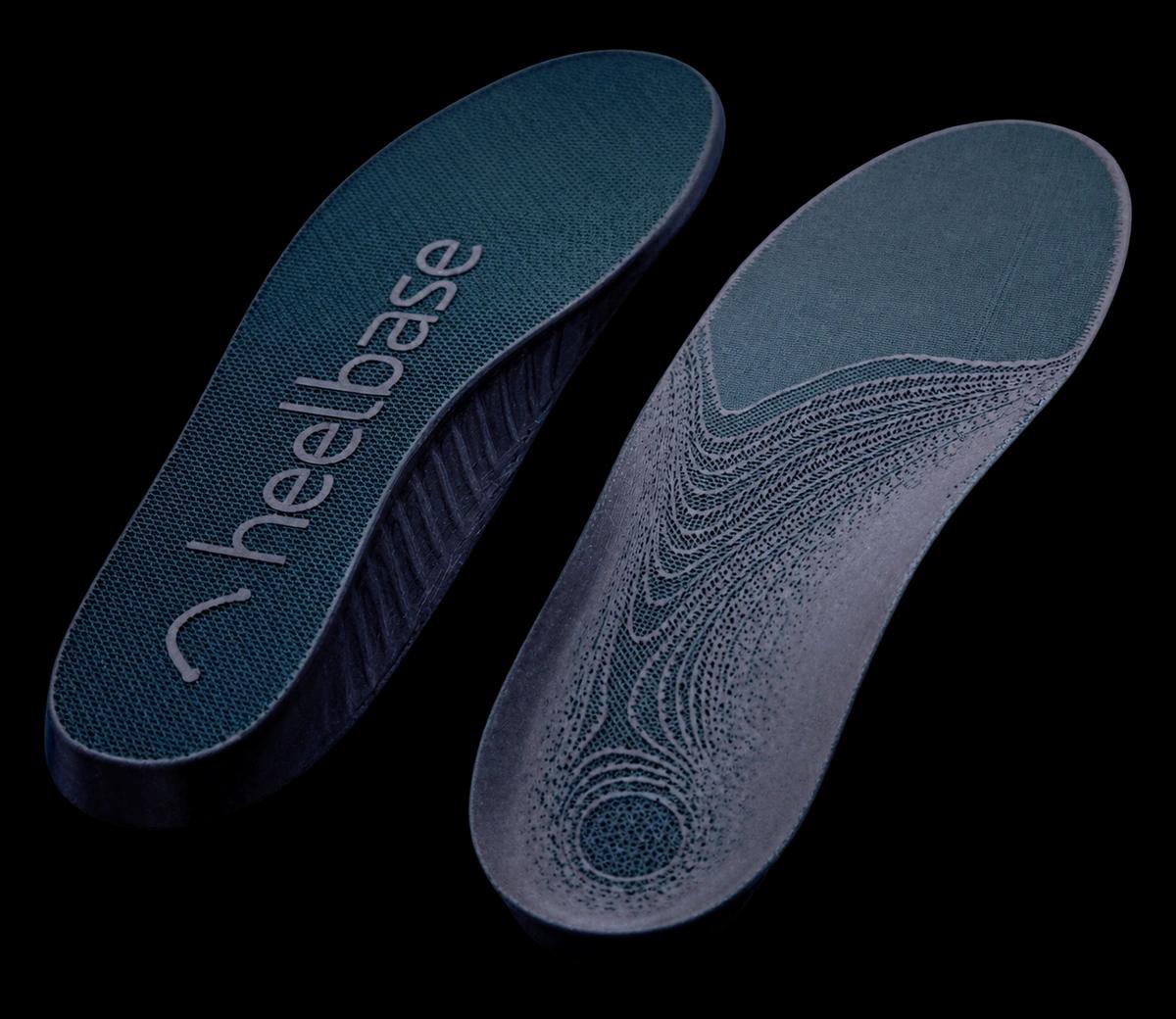
Pull the factory insole out of a court shoe that fits you well and lay it beside a tracing of your foot. The insole is longer, usually by a centimeter or more. That isn't a manufacturing error. It's the toe room the shoe was built around, and it's the reason insole length and foot length are two different numbers.
To measure insole length, take the insole out, lay it flat with the heel against a wall, and measure in a straight line to the tip of the toe, in millimeters. Insole length is longer than your heel-to-toe foot length because it includes toe room, so never compare the two numbers directly.
Below is a repeatable method for both measurements, a table that converts foot length in centimeters to US and EU sizes, and a clear rule for the moment you land between two sizes, which is where most sizing mistakes happen.
Key Takeaways
- Insole length and heel-to-toe foot length are different numbers, and the insole is usually the longer one.
- Measure an insole flat, in a straight line from heel edge to toe tip, never along its curves.
- Measure your feet standing, in your court socks, later in the day, and size to the longer foot.
- Size charts list foot length, insole length or shoe size, so check the column before you match a number.
- A full US size step is about 8.5mm, so a small measuring error can move you half a size.
- Between sizes, size up for trim-to-fit insoles and down for exact-size insoles that can't be cut.
- Re-measure when you buy new shoes, because adult feet can change with age and lengthen after pregnancy.
What Is Insole Length, and How Is It Different From Foot Length?
Insole length is the straight-line length of the insole itself, from the back edge of the heel to the furthest point of the toe. Foot length, often called heel-to-toe length, is the same measurement taken on your foot while you stand. Most shoe and insole size charts are built on foot length, not insole length.
The two numbers differ because a shoe that fits leaves space in front of your toes. Fitting guidance from the American Academy of Orthopaedic Surgeons recommends at least half an inch between your longest toe and the tip of an athletic shoe. The factory insole runs the full length of the footbed, so it spans that space as well as your foot.
| Measurement | What it measures | Where you'll see it |
|---|---|---|
| Foot length (heel to toe) | Your foot, standing, back of heel to longest toe | Most brand size charts, including HeelBase's |
| Insole length | The insole laid flat, back edge to toe tip | Some marketplace listings and replacement-insole specs |
| Shoe size | A label in the US, UK, EU or Mondopoint system | The box, the tongue and the product page |
Insole length vs heel-to-toe length: a worked example
Say your foot measures 26.7cm from heel to toe. On HeelBase's chart, that's a US men's 9. Your factory insole, which includes roughly 1.3cm or more of toe room, might measure about 28cm. Match that 28cm against the same foot-length chart and it points you to a men's 10 or 11, one or two sizes too big.
That mistake is easy to make, because the old insole is right there and a tape measure is quicker than tracing your feet. It's also a common way people end up with an insole that buckles at the toe and pushes the heel cup forward.
Why some size charts list insole length
Some size charts, particularly on marketplace listings, give insole length instead of foot length, and a few give both. Before you match any number, read the column header. If it says insole length or inner length, compare it with a measured insole. If it says foot length, compare it with your foot.
Recovery assessment
Not sure which insole is right for you?
Take our 2-minute recovery assessment and get a personalized recommendation based on your play style and foot profile.
Take the assessmentHow to Measure Insole Length, Step by Step
You'll need a hard floor, a wall or a square-edged box, and a tape measure or ruler marked in millimeters. If you haven't yet decided whether your new insole replaces the old one or sits on top of it, settle that first, since taking out the factory insole is the normal starting point in a court shoe.
- Take the insole out and let it sit flat for a minute, since thin foam liners often curl after months inside a shoe.
- Place it on the floor, top side up, with the back of the heel touching the wall or the edge of the box.
- Lay the tape flat on the floor along the insole's center line, starting at the wall.
- Read the length at the furthest point of the toe end, usually near the big toe or second toe, not the outer corner.
- Write the number down in millimeters, then repeat with the other insole and keep the longer reading.
Millimeters are worth the effort. A full US size step is one-third of an inch, about 8.5mm, and a half size is about 4mm, so a reading rounded to the nearest quarter inch can hide most of a half size.
Measuring a contoured insole
Aftermarket insoles with a deep heel cup or a raised arch don't lie perfectly flat, and a tape that follows those curves reads long. Measure the footprint instead. The simplest way is to set the insole on a sheet of paper, trace around its outline with a pencil held upright, and measure the tracing from end to end.
While the insole is out, measure the widest point across the forefoot as well. If you've ever had an insole pinch along the sides of your foot, that width figure tells you more than the length does, and it's the starting point for choosing insoles for wide feet.
If the insole won't come out
Some shoes have a liner that's glued in. You can still measure the inside length. Slide a strip of stiff card or a thin flexible ruler into the shoe along the footbed until it touches the end of the toe box, mark it level with the back of the heel at the footbed, then take it out and measure it. Do it twice and keep the longer reading.
Insole measurement mistakes to avoid
- Measuring along the arch and heel-cup curves, which adds length that isn't on the floor.
- Measuring diagonally to a corner of the toe end instead of along the center line.
- Measuring a liner that has been trimmed or crushed, which no longer reflects the shoe.
- Rounding to the nearest half inch, which can put you most of a size out.
- Treating the result as your foot length when you look up a size chart.
How to Measure Your Feet for Insoles
Your foot length is the number that actually decides your size, so it deserves more care than the insole. Measure standing, because your foot spreads and lengthens a little as it takes your weight, and that loaded shape is the one that has to fit the shoe on court.
Timing and socks change the result too. The same AAOS guidance advises trying on shoes at the end of the day or after a workout, because feet swell through the day. Measure in the socks you actually play in, since a cushioned court sock takes up more room than a thin everyday one.
The wall method
This is the most repeatable home method, and it needs a second person for best results:
- Tape a sheet of paper to a hard floor, with one short edge pressed flush against a wall.
- Stand on the paper in your court socks, heel touching the wall, with your weight spread evenly across both feet.
- Have your helper mark the tip of your longest toe with a pencil held upright, not angled under the toe.
- Measure from the wall edge of the paper to the mark, in millimeters.
- Repeat on the other foot, twice for each foot, and keep the largest reading of the longer foot.
Tracing the whole foot is a good alternative, because the outline shows your foot's width and shape as well as its length. Keep the pencil upright against your skin, as the instructions beside the HeelBase size chart advise, since an angled pencil slips under the foot and reads short. Either way, measure both feet. Most people have a small difference between left and right, and you size to the longer foot.
Why the longest toe isn't always the big toe
For some people, the second toe reaches further than the big toe. Measure to whichever toe is furthest from the wall, because that's the toe that meets the front of the shoe on a hard stop. Measuring to the big toe out of habit can leave you a few millimeters short, which is enough to change a size.
While you have the tracing, it can also help to note where the ball of your foot sits. The American Academy of Podiatric Sports Medicine suggests fitting measurements that include heel to ball as well as heel to toe, because a shoe should flex where your toes actually bend. Two feet of the same length don't always share that proportion.
Converting Foot Length to US and EU Sizes
Once you have a foot length in centimeters, converting it is simple, but it pays to know why charts disagree. US sizes step in thirds of an inch, about 8.5mm per full size. EU sizes step in two-thirds of a centimeter, about 6.7mm. The steps don't line up, so every conversion chart rounds somewhere, and brands round differently.
Women's US sizes generally run about one and a half sizes above men's for the same foot, though some brands use a one-size or two-size gap. Mondopoint, the system used for ski boots, skips the rounding entirely and labels footwear by foot length in millimeters, which is why it's the most direct of the lot.
Here's how HeelBase's own chart lines up foot length with US and EU sizes, sorted by foot length so men's and women's sizes sit side by side. Not every size is made in every model, so the product page is the final word on which sizes an insole comes in.
| Foot length (cm) | Foot length (in) | HeelBase size (US) | EU |
|---|---|---|---|
| 22.2 | 8.7 | Women's 5 | 35 |
| 23.0 | 9.1 | Women's 6 | 36 |
| 23.8 | 9.4 | Women's 7 | 38 |
| 24.1 | 9.5 | Men's 6 | 38 |
| 24.6 | 9.7 | Women's 8 | 39 |
| 24.8 | 9.8 | Men's 7 | 39 |
| 25.4 | 10.0 | Women's 9 | 40 |
| 25.7 | 10.1 | Men's 8 | 41 |
| 26.2 | 10.3 | Women's 10 | 41 |
| 26.7 | 10.5 | Men's 9 | 42 |
| 27.0 | 10.6 | Women's 11 | 43 |
| 27.3 | 10.7 | Men's 10 | 43 |
| 27.9 | 11.0 | Women's 12 | 44 |
| 28.3 | 11.1 | Men's 11 | 45 |
| 29.2 | 11.5 | Men's 12 | 46 |
| 30.1 | 11.9 | Men's 13 | 47 |
Treat any chart, this one included, as the starting point for a brand's own sizing rather than a universal rule. Two brands can put the same foot length in different sizes, which is why your measured foot length, not the size on your current shoes, is the number to carry from one brand to the next.
If you only have an insole measurement and can't measure your feet, subtract about 1.5cm, the middle of the usual toe-room range, as a rough estimate of foot length, then look that up. It's a fallback, not a method. The toe room built into a shoe varies with the brand and the shape of the toe box, so a direct foot measurement is always better.
What If You're Between Two Sizes?
Landing between two sizes is normal, since your foot doesn't know where a brand put its size breaks. The right call depends on how the insole is sized, and the difference between trim-to-fit and exact-size insoles decides which way you go.
Trim-to-fit insoles: size up
An insole designed to be trimmed can be cut shorter but never made longer. So when your foot falls between two sizes, or between two lettered bands, take the larger one and trim the toe end to match your shoe. Use the factory liner as a template, and take off a little at a time.
The cut only ever happens at the toe. The heel cup and arch are positioned from the back of the insole, so trimming the front shortens it without moving the support that sits under your heel and arch. The method for trimming insoles for court shoes comes down to small passes and a test fit after each one.
Exact-size insoles: size down
An insole made in exact sizes can't be trimmed, so the same logic runs the other way. A few millimeters short at the toe end is easy to live with, because your heel still seats in the cup and the arch stays where it should be. An insole that's too long has nowhere to go: it bows at the toe and pushes the support forward.
That's why our Drive court insole carries the opposite rule to most insoles. Drive is 3D-printed as one piece in nine exact sizes and isn't designed to be cut, so between sizes, you take the smaller one.
Because every pair is printed to the same spec, the heel cup and arch land in the same place in every Drive insole of a given size, which is the payoff for giving up the scissors. Our other two models can be trimmed along a guide on the underside, so for those, between sizes means sizing up.
| Your situation | Size up or down? | Why |
|---|---|---|
| Trim-to-fit insole, between sizes | Up | You can trim length off, never add it |
| Exact-size insole, between sizes | Down | A slightly short insole still seats your heel |
| One foot longer than the other | Size to the longer foot | A short insole on the longer foot leaves the toes unsupported |
| Shoe liner won't come out | Size the insole to your foot | The extra layer may need half a size more shoe |
| Exactly on a size line | Neither | Order the size your foot length matches |
Product spotlight
Engineered to the millimeter, not molded to a size
Drive is the first 3D-printed on-court pickleball insole, with a firmer 64 Shore A arch shell and a softer 51 Shore A heel pad printed as one continuous structure. Support tuned to where the court actually loads your foot.
Choose DriveHow to Check the Fit Inside a Court Shoe
A measurement gets you to the right size. The fit check inside the shoe confirms it, and on a court shoe it's the step that catches problems a tape measure can't.
Seat the insole heel first, press it flat along its whole length, then stand in the shoe and lace it as you would for a match. Then work through these checks:
- The insole lies flat from heel to toe, with no ripple or bow at the front.
- The back of the insole meets the back of the shoe, with no gap behind the heel.
- Your heel sits down in the heel cup, not perched on its rim.
- Standing, you have room in front of your longest toe, roughly half an inch to a thumb's width.
- Your toes can wiggle, and nothing presses on the top of them.
That toe-room range is a convention, not a precise standard. A 2026 systematic review of footwear fit guidelines rated the evidence behind recommended shoe length, width and depth as low to very low, and said exact ranges for toe gaps still need research. That review studied people with diabetes, but the lesson carries over: use the range as a guide and trust the fit test.
On court, that front room has a real job. Too little of it is a classic route to black toenails after pickleball, because hard stops and lunges drive your foot forward in the shoe and your toenails take the impact. Too much space causes the opposite problem, letting your foot slide before the shoe catches it.
Length isn't the only thing an insole changes. A thicker insole also takes up volume above your foot, so a size that's right by length can still feel cramped over the instep. Start by confirming the old liner is out, then try a lacing change, and consider a bigger shoe last. That order resolves most cases of court shoes that feel tight once an insole goes in.
When Should You Measure Your Feet Again?
Most adults stopped measuring their feet years ago, and it shows. A 2018 review of footwear fit research found that between 63% and 72% of participants were wearing shoes that didn't accommodate the width or length of their feet, and linked poor fit with foot pain, corns and calluses.
Part of the reason is that adult feet change. The American Academy of Podiatric Sports Medicine notes that foot size can gradually change as you age, and advises having your feet measured each time you buy shoes. Pregnancy is another trigger. In a 2013 study of 49 women, arch height dropped and foot length increased between early pregnancy and 19 weeks after birth, with first pregnancies accounting for the increase in length.
For a pickleball player, a sensible routine looks like this:
- Measure both feet whenever you buy new court shoes or new insoles.
- Measure again after a pregnancy, a significant change in body weight, or a foot injury.
- Re-check if a size you've always worn starts to feel short or tight.
- Keep your last measurements in millimeters so you can compare like with like.
A minute with a wall, a pencil and a tape measure costs nothing, and it protects the money you spend on the shoe and the insole that goes inside it.
HeelBase insoles
Support designed around court movement
Compare HeelBase options for everyday court play, tournament-grade support, and off-court comfort between sessions.
Explore the lineupFrequently Asked Questions
What is insole length?
Insole length is the straight-line length of an insole from the back of the heel to the tip of the toe, measured with the insole laid flat. It's longer than the foot that wears it, because it spans the toe room at the front of the shoe as well as the foot itself.
Is insole length the same as foot length?
No, insole length is usually longer than your heel-to-toe foot length. A shoe that fits leaves space in front of your longest toe, and the insole runs into that space. That's why you should compare an insole measurement only with an insole-length chart, and a foot measurement only with a foot-length chart.
How much longer should an insole be than my foot?
As a rough guide, an insole that fills a well-fitting shoe is about 1 to 2cm longer than the foot. Fitting advice puts the toe room at about half an inch to a thumb's width, and the exact figure varies with the brand and the shape of the toe box, so the fit check in the shoe matters more than the number.
How do I convert insole length to shoe size?
Convert insole length to shoe size by estimating your foot length first: subtract about 1.5cm, then look that up on the brand's foot-length chart. Because toe room varies between shoes, this is only an estimate. Measuring your foot directly, standing and in your court socks, gives a far more reliable answer.
Should I measure my feet sitting or standing?
Measure your feet standing, with your weight spread evenly, because your foot lengthens and spreads slightly under load. That loaded shape is the one that has to fit the shoe when you play, and a seated measurement can read short. Measure later in the day if you can, in the socks you play in.
Do I size insoles to my bigger foot?
Yes, size insoles to your longer foot. Most people have a small difference between left and right, and an insole that's short for the longer foot leaves your toes unsupported at the front. With a trimmable insole, you can then trim the shorter foot's insole at the toe end. An exact-size insole stays as it is.
Should I size up or down for insoles?
Size up for trim-to-fit insoles and down for exact-size insoles when you're between sizes. A trimmable insole can be cut shorter but never made longer, so the larger size gives you material to work with. An exact-size insole can't be cut, and a few millimeters short at the toe fits better than one that bows.
Can I cut an insole that's too long?
You can cut an insole that's too long only if its maker says it's designed to be trimmed. Trim the toe end alone, in small passes, using your factory liner as a template. Never cut an insole sold in exact sizes, because its structure isn't designed to be trimmed, and a bad cut can't be undone.
Size Down Only When the Insole Can't Be Cut
Most sizing problems start with one mix-up: an insole length read against a foot-length chart. Measure your foot standing, in court socks, to the longest toe, and keep the number in millimeters. Measure an insole flat and in a straight line, and compare it only with other insoles.
Then let the insole's design make the final call. If it's built to be trimmed, size up and cut the toe end to your shoe. If it's made in exact sizes, take the smaller size when you're in doubt, because it can't be shortened later. If you're still choosing which insole to fit, the HeelBase assessment takes about two minutes and matches the model to how you play.