Shin splints usually show up after a burst of enthusiasm. You add a third weekly session, join a league, or come back from a winter off, and a week later the inside of your shin aches every time you split-step. It's one of the most common overuse complaints in sports with repeated landings, and pickleball has plenty of them.
Shin splints from pickleball usually come from doing too much too soon on hard courts, so the muscles and bone along the inner shin can't keep up. Feet play a part too: a low or collapsing arch adds strain, and arch-supporting insoles have better evidence for prevention than cushioned ones.
Below, you'll find what shin splints are, why pickleball brings them on, how to tell them apart from a stress fracture, what the research says about insoles and shoes, and a simple plan for easing back onto the court.
Key Takeaways
- Shin splints cause a dull ache along the inner edge of the shinbone, usually in the lower half.
- Sudden jumps in playing time on hard courts are the most common trigger in pickleball.
- A larger arch drop is one of the few foot measures consistently linked with shin splints.
- Insoles that limit overpronation helped prevent shin splints in trials, while shock-absorbing insoles showed no clear effect.
- Pain at one sharp spot, at night, or when hopping points toward a stress fracture instead.
- Cutting back, not stopping completely, lets most players stay active while the shin settles.
- Calf, shin and hip strength work supports a steady return to full sessions.
What Are Shin Splints?
Shin splints is the everyday name for medial tibial stress syndrome: pain along the inner border of the shinbone, usually over the lower two-thirds of the leg. The ache is spread over a stretch of bone several inches long instead of one spot, and it's usually tender when you press along that edge.
The pain tends to follow a pattern. Early on it hurts at the start of a session, eases once you're warm, then returns afterward. If the loading continues, it can last through the whole game and linger into the next day. That progression is your cue to change something before it turns into a bigger problem.
Researchers still debate exactly what's happening in the leg. The leading explanation is that repeated loading irritates the bone and the tissue where the calf muscles attach, faster than the bone can adapt. Either way, the practical message is the same: the leg is being asked to absorb more than it's ready for.
Why Does Pickleball Cause Shin Splints?
Pickleball looks low-impact, but your legs feel every landing. The split step before each shot, quick shuffles along the kitchen line, short sprints for a drop shot, and stops on a hard surface add up to hundreds of small impacts in an evening. The muscles along the shin work to control each of them.
A few situations make shin splints far more likely:
- A sudden increase in play. Going from two sessions a week to five is the classic setup, especially in your first months of the sport.
- Hard courts. Most outdoor courts are concrete or asphalt, which give back very little compared with a wooden gym floor.
- Playing on your toes. Staying up on the balls of your feet for long stretches keeps the calf and shin muscles working without a break.
- Worn or unsuitable shoes. A compressed midsole, or a running shoe with a soft, high heel, lets the foot roll more on each landing.
- Coming back after a break. Fitness returns faster than bone and tendon tolerance, so your first weeks back carry more risk.
Tournament weekends deserve a mention of their own. Several matches a day, with little recovery between them, can push a leg that copes fine with weekly league play past its limit.
Recovery assessment
Not sure how much your feet are contributing?
Answer a few questions about your feet, your shoes and how often you play. The HeelBase assessment points you toward the support that fits your routine.
Start the assessmentWho Is Most Likely to Get Shin Splints?
A 2017 meta-analysis of shin splint risk factors pooled data from active people, mostly runners and military recruits. Five factors stood out: female sex, higher body weight, a larger drop in the arch when standing, a previous running injury, and greater hip rotation range. Women had more than twice the odds of developing shin splints.
Most of those studies weren't in pickleball, but the pattern fits what many players notice. New players, people returning from a layoff and heavier players all load their shins harder on hard courts, and players whose arches flatten noticeably when they stand have one more source of strain to manage.
Can Your Feet Cause Shin Splints?
They can add to the load. Several muscles that control your arch, including the tibialis posterior and the soleus, attach along the inner shinbone. When your arch flattens quickly under load, those muscles work harder to slow it down, and the shin takes more of the pull with every landing.
That's why arch drop keeps appearing in the research, and why players who show signs of overpronation on court deserve a closer look at their feet. It doesn't mean flat feet guarantee shin splints. Plenty of players with low arches never get them, and plenty with high arches do.
High, rigid arches carry a different risk. They absorb less shock, so more of each landing travels straight up the leg. Shin pain in a high-arched player is often more about impact and training load than about the arch collapsing.
A Simple Arch Drop Check
- Sit with your bare foot flat on the floor and find the bony bump on the inside of your midfoot, just in front of the ankle.
- Mark it lightly with a washable pen, or note its height against a card held upright beside your foot.
- Stand up with your weight spread evenly on both feet, then look at the mark again.
- Compare the two heights. A drop of more than about a centimeter suggests your arch flattens noticeably under load.
This is a rough home check, not a diagnosis. A large drop on the sore side makes foot support more likely to help, and the approach that suits flat feet on court applies here too: an arch that meets the foot along its length, in a shoe with a firm heel.
Why Does Only One Shin Hurt?
Shin splints often start on one side. Your dominant leg may do more of the push-offs and lunges, or one foot may flatten more than the other. Compare your arch drop on both sides, and look at the wear on each shoe. Uneven wear, especially along the inner edge of one heel, is a useful clue.
Old injuries count as well. A previous ankle sprain or calf strain on one side can change how that leg absorbs landings for months afterward, even once it feels fine. If the sore shin is on your previously injured side, rebuilding strength on that leg deserves extra attention.
Shin Splints or Something Else?
Not every sore shin is shin splints. The main things to rule out are a stress fracture, a calf strain and, less commonly, exertional compartment syndrome, where pressure builds inside the muscles during exercise. They feel different, and they need different responses.
| Condition | Where it hurts | What it feels like | What to do |
|---|---|---|---|
| Shin splints | Inner edge of the shin, over several inches | Dull ache, tender along the bone, eases once warm early on | Cut back load, then build up gradually |
| Stress fracture | One small spot on the bone | Sharp, pinpoint tenderness; hurts to hop; may ache at night | Stop playing and get it checked |
| Calf strain | Muscle at the back of the lower leg | Sudden pull or twinge, often on a push-off | Rest it, then rebuild calf strength |
| Compartment syndrome | Front or outer side of the lower leg | Tightness, cramping or numbness that builds in play and fades with rest | See a sports medicine doctor |
Stress fractures and shin splints sit on the same spectrum of bone overload, so habits that prevent one tend to help with the other. A 2023 review of mostly military trials linked foot orthoses with fewer bone stress injuries, though the authors rated the evidence low quality and noted that women and athletes were underrepresented.
Do Insoles Help Shin Splints?
For prevention, the evidence favors arch support over cushioning. A 2025 meta-analysis of trials found that insoles designed to limit overpronation reduced the risk of shin splints, with moderate certainty, while shock-absorbing insoles showed no significant effect, with high certainty. Neuromuscular training also lowered the risk, with high certainty.
That distinction is useful when you shop. A soft gel or foam pad may feel kind on a sore shin, but the trials suggest it does little to prevent the problem. What helped was support that controls how far and how fast the arch drops.
For players who already have shin pain, the evidence is thinner. A review of shin splints in recreational runners found that arch-support orthoses changed how pressure spread across the foot and reduced pain in the studies available, but the authors described those studies as small and of poor methodological quality.
So an insole is a reasonable part of the plan, not the whole plan. Pair it with a lighter playing load and strength work, and judge it over a few weeks instead of one session. When you choose one, look for these features:
- A firm arch that meets your foot along its length, not a soft dome.
- A deep heel cup that keeps the heel centered as you land.
- A full-length design that replaces your shoe's factory liner, so the shoe still has room for your foot.
- Enough flexibility at the forefoot to let you push off naturally.
Do Your Shoes Matter for Shin Splints?
Yes. Court shoes keep your foot on a flatter, more stable base than running shoes, which counts on every lateral step. Running shoes are built for straight-line cushioning, and their soft, raised heels give the foot more room to roll when you change direction.
Midsoles also lose their bounce long before the upper looks tired. If shin pain has crept in months after you bought your shoes, check for worn-out court shoes, especially compressed foam under the heel and a smooth outsole.
Surface makes a difference as well. If you have a choice, mix in sessions on indoor wooden or cushioned courts while your shins settle, and save long outdoor sessions on concrete for when they feel normal again.
Do Compression Sleeves or Taping Help?
Some players like the feel of a compression sleeve or kinesiology tape on a sore shin. If it makes a session more comfortable, there's little harm in it. The evidence that either one changes the course of shin splints is limited, though, and the prevention trials found no evidence that special socks help.
Think of sleeves and tape as comfort aids, not a reason to keep your playing load the same. If you find yourself relying on them to get through every session, that's a sign the load is still too high.
How Do You Get Back on Court With Shin Splints?
Most players don't need to stop completely. The goal is to drop your load below the level that irritates the shin, let it settle, then build back up in steps. A simple pain scale helps: during and after play, keep the shin at 3 out of 10 or lower, and make sure it's no worse the next morning.
- Cut your playing time by about half for a week or two, and skip tournaments and back-to-back sessions.
- Keep your fitness with low-impact exercise such as cycling or swimming on the days you'd usually play.
- When daily activity is pain-free, return to drills and short games, then add one session or about 20 percent more court time each week.
- If pain climbs above 3 out of 10, or is worse the next morning, drop back to the previous step for a few days.
Ice can ease soreness after play, but it doesn't change the load on the bone. If the shin only feels fine because you've numbed it, you've probably moved up too quickly. A proper warm-up of foot and ankle drills before each session also eases the legs into the first few landings.
Product spotlight
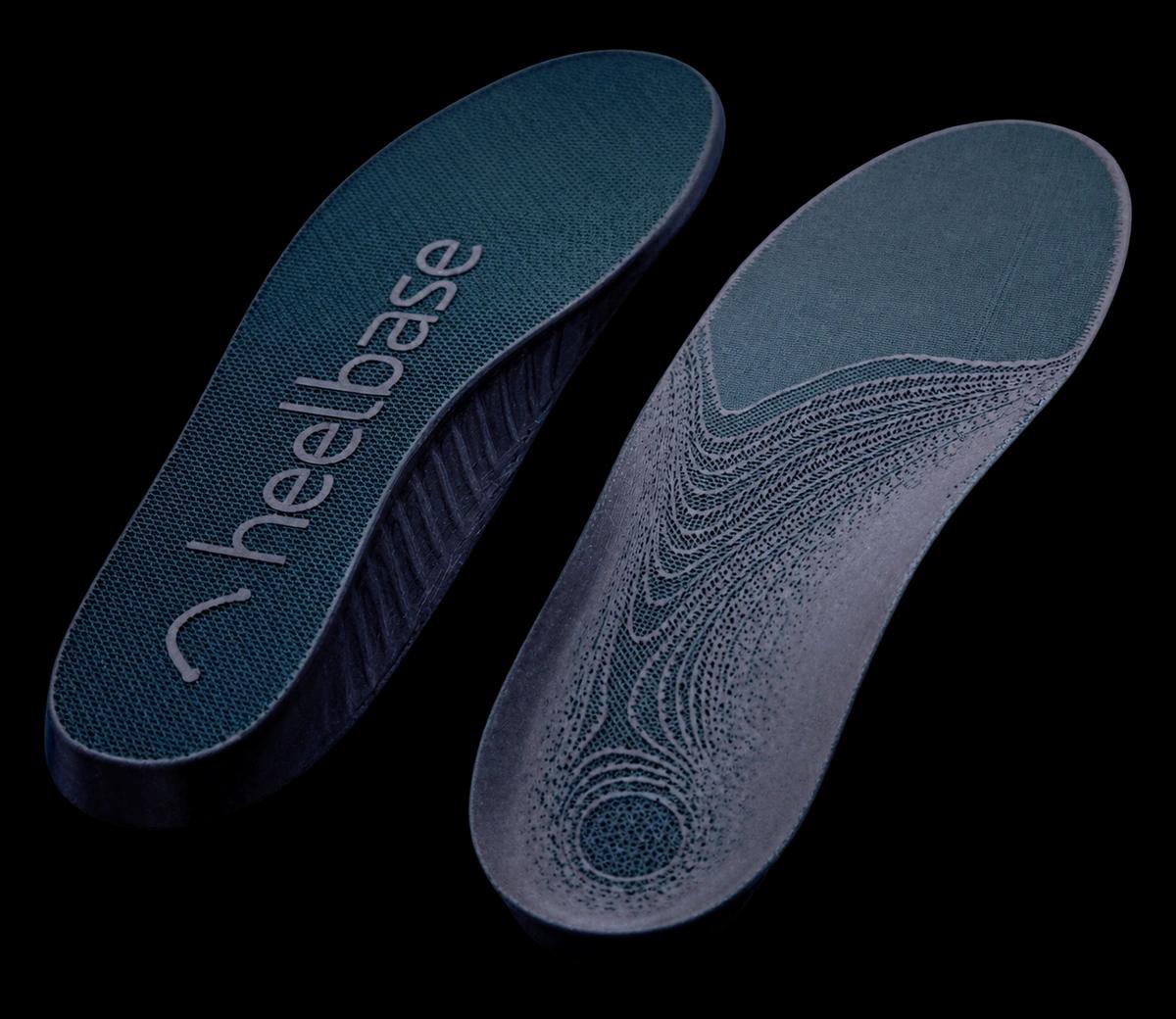
The first 3D-printed insole for the court
Drive is printed as one continuous piece, engineered to the millimeter, with no glue lines and no bonded foams to separate. An 11.3mm printed heel pocket and shaped arch shell keep load off your plantar fascia through long sessions.
Shop DriveWhich Exercises Help Shin Splints?
Strength work gives the shin more support. The meta-analysis that backed arch-supporting insoles found the same for neuromuscular training, which combines strength, balance and movement control. These four are a good start, two or three times a week:
- Calf raises. Rise onto your toes and lower slowly, on both feet at first, then one. Work up to three sets of 15.
- Toe raises against a wall. Lean your back on a wall with your heels a foot away, then lift your toes toward your shins to work the front of the leg.
- Single-leg balance. Stand on one foot for 30 seconds, then try it with your eyes closed or on a cushion.
- Side-lying leg lifts. Lifting the top leg strengthens the hip muscles that help control how your knee and shin line up when you land.
Foot strength helps too, because the small muscles in the arch share the work of controlling how it drops. A short routine of foot strengthening exercises fits easily around these on the same days.
How Long Do Shin Splints Last?
With sensible changes, many cases settle over a few weeks. Shin splints that have built up over months, or that you've kept playing through, can take longer, sometimes several months, because the bone needs time to adapt to the load you put on it.
The return is often bumpy. A good week can tempt you to jump straight back to full volume, and then the ache returns. Steady progress gets you back to full sessions sooner than a cycle of restarts.
Recovery between sessions counts too. Sleep, easy movement on rest days and a short foot recovery routine after long days all help your legs absorb the next session.
When Should You See Someone About Shin Pain?
See a sports medicine doctor or physical therapist if any of these apply:
- Pain is focused on one small spot instead of spread along the bone.
- It hurts to hop on the affected leg, or to walk normally.
- The shin aches at rest or wakes you at night.
- There's swelling, numbness, tingling or a change in skin color in the lower leg.
- Pain keeps getting worse despite two weeks of cutting back.
- Tightness or cramping builds the same way every session, then fades soon after you stop.
If your feet seem to be part of the story, a podiatrist can assess your foot mechanics and advise on support. Knowing what podiatrist advice on insoles can add helps you decide whether a custom device is a sensible next step for you.
Where HeelBase Drive Fits
Drive is the court insole we make, so keep that in mind as you read this part. The research above points toward firm arch support over soft cushioning, and that's how Drive is built: a 64 Shore A arch shell with a 16mm arch cradle, paired with a softer 51 Shore A heel pad, printed together as one piece.
It sits in place of your shoe's factory liner, comes in nine exact sizes, and has an 11.3mm heel cup to keep your heel centered on landing. It's never trimmed, so the arch sits where it was designed to sit for your size.
It won't undo a sudden jump in playing time on its own, and it doesn't replace an assessment for the warning signs above. If your arch drop check points to foot support, HeelBase Drive can be one part of a steady return to full sessions.
HeelBase insoles
Pickleball support starts inside your shoes
HeelBase makes three distinct insoles: a 3D-printed insole for regular court play, a reinforced insole for tournament volume, and a cushioned insole for off-court daily wear.
View HeelBase insolesFrequently Asked Questions
What causes shin splints in pickleball?
Usually a jump in playing time on hard courts, which loads the inner shin faster than the bone and muscles can adapt. Worn shoes, a low or collapsing arch, previous leg injuries and returning after a break all add to the risk.
Can flat feet cause shin splints?
They can contribute. A larger arch drop when standing is one of the few foot measures linked with shin splints in research, because the muscles that control the arch attach along the inner shin. Plenty of flat-footed players never get them, so it's one factor among several.
Do insoles help with shin splints?
Insoles designed to limit overpronation reduced the risk of shin splints in trials, while shock-absorbing insoles showed no clear effect. For existing shin pain, arch supports may ease symptoms, but the studies are small. Use them alongside a lighter playing load and strength work.
Should I keep playing pickleball with shin splints?
Many players can keep playing at a reduced level if the pain stays mild, around 3 out of 10 or lower, and isn't worse the next morning. Stop and get checked if the pain sits at one spot, hurts when you hop, or aches at night.
How long do shin splints take to go away?
Many cases settle within a few weeks once you cut back and build up gradually. Long-standing shin splints, or ones you've played through, can take several months. Returning to full volume too quickly is the most common reason they come back.
Are shin splints the same as a stress fracture?
No, though they're related. Shin splints cause a spread-out ache along the inner shin, while a stress fracture usually hurts at one small spot and often aches at rest. A suspected stress fracture needs imaging and a break from play.
What shoes help prevent shin splints in pickleball?
Court shoes with a stable, fairly flat base and a firm heel counter, replaced before the midsole is worn flat. Avoid playing in running shoes, which are built for straight-line movement and let the foot roll more when you change direction.
Ease Off, Support the Arch, Build Back Up
Shin splints from pickleball are common and usually manageable. Cut back before the ache turns sharp, check your shoes and your arch drop, add strength work, and return in steps you can sustain. Take any pinpoint pain, night pain or pain on hopping seriously, and get it assessed.
If you're unsure what kind of support suits your feet and your schedule, the HeelBase assessment matches your answers to an insole in a couple of minutes.