Most insole advice is written for heel pain, where the main job is to take load off one sore spot. Ankle pain asks for something else. The insole has to steady how your heel and midfoot sit while you push off sideways, and on a pickleball court you do that hundreds of times a session.
The best insoles for ankle pain in pickleball combine a deep heel cup that centers your heel, a firm midfoot that resists twisting, and a profile slim enough to keep your heel seated in a court shoe. Match the support to where your ankle hurts, and treat it as one part of the fix, because no insole stops a sprain.
Below, we map ankle pain by location, explain the features that help each type, and compare six insoles using their makers' own published details. We make one of them, and we say so where it appears.
Key Takeaways
- Start with where it hurts: outer, inner, back or front of the ankle each call for different support.
- A deep, centering heel cup and a firm midfoot do more for ankle pain than extra cushioning.
- Outer-ankle trouble favors heel security and grip; inner-ankle pain favors a firmer arch and medial support.
- A slim profile keeps your heel seated in the shoe, so the heel counter can still do its job.
- Bracing and balance training have stronger evidence for preventing repeat sprains than any insole.
- We list HeelBase Drive first and disclose it; the other five follow each maker's published details.
- Swelling, bruising or an ankle that keeps giving way needs a clinician before a new insole.
Where Exactly Does Your Ankle Hurt?
Ankle pain in pickleball isn't one problem. A 2026 systematic review of lower extremity injuries in pickleball found sprains, strains and fractures were the most commonly reported injuries, with falls, lunging forward and rolling the foot or ankle inward among the main mechanisms. Age 50 and over was a consistent risk factor.
The causes behind pickleball ankle pain range from one bad roll to months of repeated lateral load, and each leaves a different kind of soreness. An insole helps some far more than others, so use the location of your pain to decide which features to prioritize:
| Where it hurts | Often linked with | What an insole can contribute |
|---|---|---|
| Outer ankle | Past rolls, a loose heel in the shoe, high arches | A centering heel cup, grip, and a slim fit that keeps the heel seated |
| Inner ankle and arch | Flat or collapsing arches, overpronation | A firm arch, a deep heel cup, and medial support |
| Back of the ankle | Achilles irritation | Limited; footwear and load management matter more |
| Front of the ankle | Pinching at the bottom of a deep lunge | Little; this one needs an assessment |
| General ache after long sessions | Fatigue and repeated lateral load | Support that stays consistent from the first game to the last |
Inner-ankle pain deserves a closer look, because it's where support underfoot has the clearest role. Pain along the inside of the ankle and arch can come from the posterior tibial tendon, and Cleveland Clinic lists orthotics that take stress off the tendon among its conservative treatments, alongside physical therapy. A clinician should confirm that diagnosis, and a prescribed orthotic isn't the same as a shop-bought insole.
Pain at the back of the ankle is usually a different story. If it sits in the cord above your heel, read up on Achilles pain after pickleball before you buy anything, because an insole plays only a small part there. The same goes for a sharp pinch at the front of the ankle when you lunge deep.
Recovery assessment
Find the right support for your game
Answer a few quick questions about your symptoms, playing volume, and foot history to see which HeelBase insole best fits your needs.
Find my matchWhat Should You Look For in an Insole for Ankle Pain?
Five features separate an insole that steadies your ankle from one that only cushions your foot. Not every player needs all five, and the location table above tells you which to weigh most heavily.
A heel cup that centers your heel
Your heel bone sits directly under the ankle joint, so where it lands decides how the ankle starts every movement. A deeper, firmer heel cup wraps the fat pad and holds the heel near the middle of the insole, instead of letting it drift toward an edge as you plant and push. For outer-ankle trouble in particular, heel cup depth earns more attention than arch height.
Midfoot structure that resists twisting
On a lateral push-off, the foot twists through the midfoot as well as bending at the toes. A structured shell under the arch resists that twist, which keeps the foot working as one unit. Soft foam alone compresses and lets the midfoot sag, and the ankle above it ends up absorbing the difference.
A top surface your foot won't slide on
If your foot slides on the insole during a hard change of direction, it reaches the edge of the shoe before the shoe can respond. A grippy or textured top layer helps your foot and the insole move as one, which makes it a priority if your outer ankle is the sore side.
A profile that keeps your heel seated
A thick insole lifts your heel higher inside the shoe, so the heel counter grips less of it. That's the opposite of what an unstable ankle needs. In a snug court shoe, a slimmer insole that replaces the factory liner usually beats a thicker one that sits on top of it.
Medial support if your arch collapses
If your arch flattens noticeably when you stand, the inside of your ankle carries extra load with every step. A firmer arch, and in some designs a medial post that angles the heel platform slightly, is built to limit that inward roll. If that describes your feet, managing overpronation on the court is as much about strength and footwear as it is about the insole.
How We Chose These Insoles
Every insole here pairs a heel cup with structured arch support and is designed for athletic shoes or listed by its maker for court play. Each description comes from the maker's own product page at the time of writing. We don't score them, and we don't repeat their clinical or endorsement claims.
The order isn't a ranking. Drive comes first because we built it for court players under exactly this kind of lateral load, and you should read that placement knowing we make it. The rest are grouped by what they suit best, starting with the court-specific option and moving toward the firmest structure.
If your ankles are fine and you want a scored comparison of general court insoles, our list of the best pickleball insoles weighs lateral stability, heel positioning, weight and track record across ten products.
The Best Insoles for Ankle Pain at a Glance
| Insole | Heel | Arch and midfoot | Fit in a court shoe | Best for |
|---|---|---|---|---|
| HeelBase Drive | 11.3mm printed heel cup | Firm printed arch shell, 16mm cradle | Nine exact sizes, replaces the liner | Regular play, consistent heel position |
| CURREX PICKLEBALLPRO | Deep heel cup, decoupled heel | High, Medium or Low arch profile | Size bands, trim to fit | Lateral play and foot slide |
| PowerStep Pinnacle Maxx Support | Deep heel cradle, angled heel post | Firm shell with a 2-degree medial post | 12 sizes, removable-liner shoes | Inner-ankle strain, overpronation |
| Superfeet All-Purpose Support Medium Arch | Heel cup that positions the heel | Stabilizer cap | Moderate to tight footwear, trim to fit | Structured support in a snug shoe |
| Protalus T-100 | Deep heel cup | Firm yet flexible arch | Thinner fit, replaces the liner | Overpronation in everyday sneakers |
| Tread Labs Pace | Deep heel cup | Extra firm, four arch heights | Arch support plus replaceable top cover | Heavy loading, very firm support |
The Shortlist, Insole by Insole
Each entry covers what the maker says the insole is built to do, how it fits, and when another option may suit you better. Those fit notes come from each maker's own guidance, and every entry closes with who it suits and when to look elsewhere.
HeelBase Drive: a printed heel cup that lands in the same place
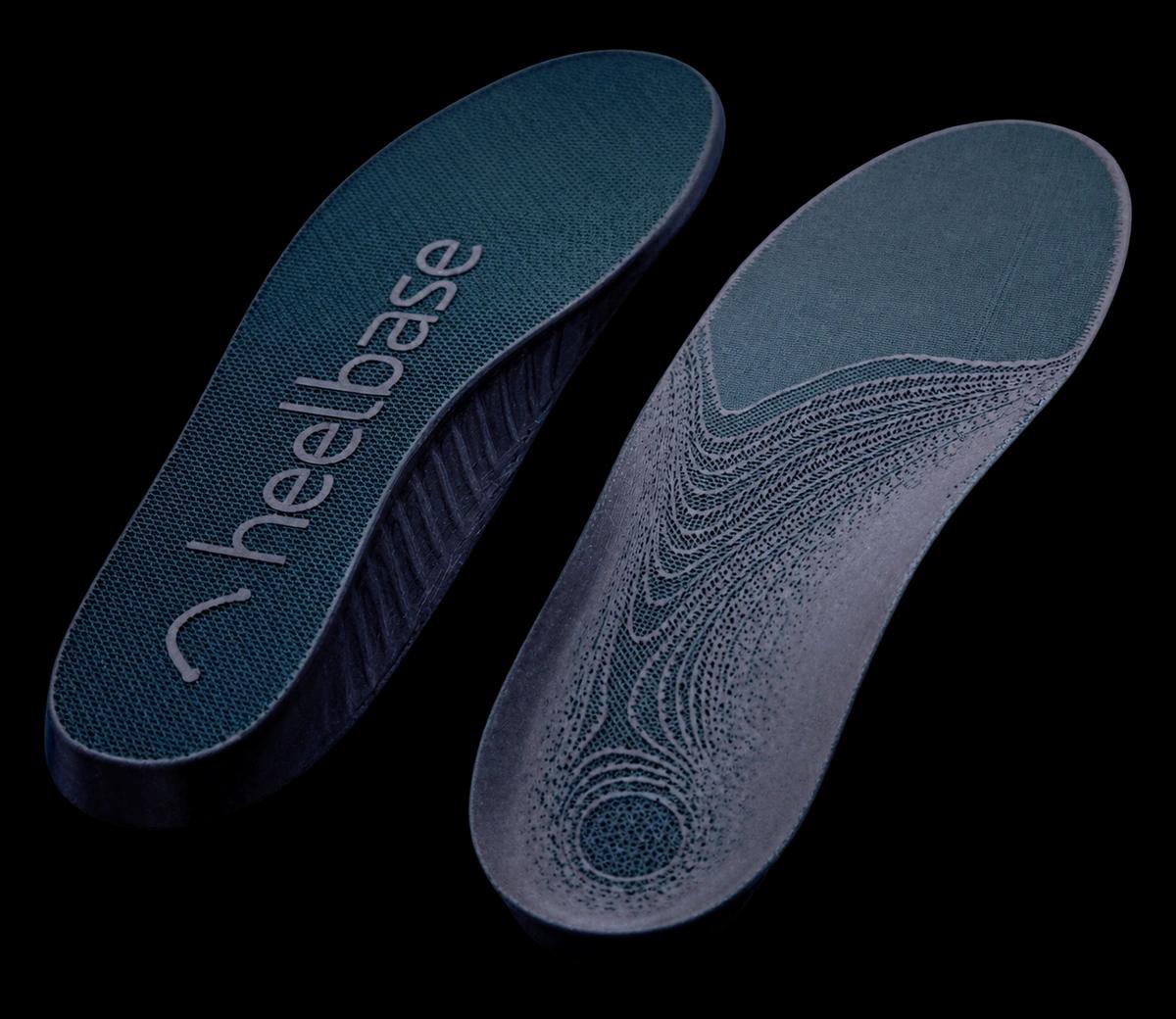
We print our Drive court insole as a single piece, and it was the first 3D-printed insole made for on-court pickleball. The firm 64 Shore A arch shell and the softer 51 Shore A heel pad are a single structure, so there's no glue line to shear apart under repeated lateral load. The 11.3mm heel cup and 16mm arch cradle hold the heel and arch in position.
For an ankle, the useful detail is consistency. Every Drive insole is printed to the same spec in nine exact sizes, so the heel cup sits where it was designed to sit for your size instead of wherever a trim line ended up. At 54.9g, it adds very little weight to a shoe you're moving sideways all session.
- Consider it if: you play regularly and want your heel held in the same place every session, with no trimming.
- Think twice if: you want a medial post, a choice of arch heights, or a brand with a longer track record, since Drive is newer to market than the others here.
CURREX PICKLEBALLPRO: grip and a decoupled heel for lateral play
CURREX designs the PICKLEBALLPRO for pickleball and describes a deep heel cup for stability, a fully decoupled heel that lets the heel and forefoot work independently, and an anti-slip Super Grip top layer for secure lateral movement. It comes in High, Medium and Low arch profiles, and CURREX publishes a guide to help you choose.
- Consider it if: your foot tends to slide in the shoe on hard cuts, and you can identify your arch profile.
- Think twice if: you'd rather not trim, since it's sold in size bands and cut to length.
PowerStep Pinnacle Maxx Support: a medial post for inner-ankle strain
PowerStep describes the Pinnacle Maxx Support as its signature arch shape with a firmer shell and an angled heel platform. The firm but flexible polypropylene shell carries a 2-degree medial post, which PowerStep says is designed to keep the feet from rolling inward, and it positions the model for moderate to severe overpronation.
- Consider it if: your pain sits on the inside of the ankle and your arches flatten when you stand.
- Think twice if: you want a court-specific design, since PowerStep lists athletic walking and running, work and casual shoes.
Superfeet All-Purpose Support Medium Arch: structure for a snug court shoe
Superfeet describes a stabilizer cap that gives this insole its structure and a heel cup that encapsulates and positions the heel. It's listed for moderate to tight-fitting footwear, which suits many court shoes, and it's trimmed to fit. Superfeet suggests sizing half a size up if you're between sizes. The High Arch version is aimed at roomier footwear.
- Consider it if: you have a medium arch and a close-fitting court shoe.
- Think twice if: your arch is noticeably high or low, or you'd rather not trim.
Protalus T-100: a deep heel cup in a thinner fit
Protalus builds its range around heel alignment. The T-100 is its thinner fit for sneakers and everyday shoes, with a deep heel cup and firm yet flexible arch support, and Protalus lists flat feet and overpronation as what it's designed for. The deeper-walled M-100 is aimed at boots and roomier shoes.
- Consider it if: your inner ankle aches and you want a deep heel cup without much added bulk.
- Think twice if: you play in a very low-volume court shoe, and check the fit before your first full session.
Tread Labs Pace: extra-firm support in four arch heights
Tread Labs describes the Pace as extra firm, with a deep heel cup, and points it at severe overpronators and players who are especially heavy on their feet. It's a two-part system, a molded arch support with a replaceable top cover, offered in four arch heights.
- Consider it if: you want the firmest structure on this list and can match your arch height.
- Think twice if: you prefer a softer feel, or your court shoe has little spare volume for a two-part insole.
Product spotlight
Stop sliding around inside your shoes
Drive's printed 11.3mm heel pocket holds your foot in place through shuffle steps and direction changes, while the engineered arch spreads pressure away from the plantar fascia instead of concentrating it.
Shop on-court supportWhat Can't an Insole Do for Your Ankle?
An insole changes what your foot stands on. It doesn't change how fast your ankle reacts when you land on the edge of your shoe, and that's where most rolls happen. Keep your expectations there and you'll judge any insole fairly.
The research is clear about what prevents repeat sprains. When Doherty and colleagues pooled 46 systematic reviews in 2017, they concluded that bracing has strong evidence for preventing a sprain from recurring, with neuromuscular training backed by moderate evidence. That's the benchmark any insole should be measured against.
Insoles have been tested for balance, with mixed results. A 2023 systematic review of supports for chronic ankle instability found elastic ankle supports, kinesiology tape and textured insoles showed potential benefits for postural stability, while the effects of arch support insoles were inconsistent across studies.
None of that makes an insole pointless for ankle pain. A centered heel and a supported arch can ease the load behind inner-ankle soreness and make your footing feel more secure. But if your ankle rolls, the bigger wins come from preventing ankle rolls in the first place, through single-leg balance work, ankle strength and court shoes that still hold their shape.
See a clinician promptly, rather than shopping for support, if any of these apply:
- You can't put weight on the foot, or walking is painful after a roll.
- Swelling or bruising spreads quickly around the ankle.
- Pain sits right on the bony points of the ankle or the outer foot.
- You feel numbness, tingling or weakness when you push off.
- Inner-ankle pain is getting worse over weeks, or your arch looks flatter than it used to.
Which Insole Should You Get for Ankle Pain?
Use the side that hurts and the way you play to narrow the shortlist to one or two options:
Outer-ankle soreness or a history of rolls
Prioritize heel security, grip and a slim fit. Drive holds the heel in a printed cup that sits in the same place every time, and the CURREX PICKLEBALLPRO adds a grip layer for players whose foot slides on hard cuts. Pair either one with a brace and balance work.
Inner-ankle pain with flat or collapsing arches
Prioritize a firm arch and medial control. The PowerStep Pinnacle Maxx Support carries a 2-degree medial post, the Protalus T-100 pairs a deep heel cup with a thinner fit, and the Tread Labs Pace offers the firmest structure here. If the pain is building, get it assessed first.
High arches and outer-edge loading
A high, rigid arch tends to load the outer edge of the foot, which can leave the outer ankle sore after long sessions. Look for arch contact along the whole arch and a heel cup that centers you. Players with high arches often do best with a selectable profile, such as the CURREX High or the Superfeet High Arch in a roomier shoe.
Tournament days and heavy weekly volume
When your ankle aches late in long days, structure that holds up matters more than weight. HeelBase Apex is the structured one in our range: a 14mm heel cup, the deepest on court, and a TPU arch shell that braces the midfoot at three load-bearing points so the arch holds its shape under a lateral cut. Drive and Apex are built for different sessions, so pick by how yours actually run.
How Do You Know an Insole Is Helping Your Ankle?
Give a new insole a structured trial instead of judging it on the first rally. Firm support can take a few sessions to settle, and ankle soreness often shows up the next morning rather than during play. Work through these steps:
- At home, check that the insole lies flat and your heel doesn't slip when you rise onto your toes.
- Start with a practice session: side shuffles, split-steps and controlled lunges at moderate pace.
- Notice whether your foot slides on the insole during cuts, or presses against the side of the shoe.
- Track where you're sore the next morning over two or three sessions, not just whether you're sore.
- Stop and reassess if you feel sharp pain, or soreness moves somewhere new.
That last step catches a common mismatch. If inner-ankle soreness eases but the outer edge of your foot or ankle starts to ache, the arch or medial support may be more than your foot wants, and a lower profile or a less aggressive post is worth trying.
Whichever insole you choose, give your ankle a proper start to every session. A few minutes of foot and ankle warm-ups before your first game prepares the muscles that react when your foot lands awkwardly, which no insole can do for you.
HeelBase insoles
Ready for support built for pickleball?
HeelBase insoles are engineered for pickleball's lateral load, with deep heel cups, midfoot bracing, and rollover resistance built in rather than borrowed from running shoes.
Get your insolesFrequently Asked Questions
What are the best insoles for ankle pain?
The best insoles for ankle pain pair a deep, centering heel cup with a firm midfoot and fit your shoe without lifting your heel. For pickleball, that includes HeelBase Drive, the CURREX PICKLEBALLPRO and the PowerStep Pinnacle Maxx Support, depending on where it hurts. Outer-ankle pain favors grip and heel security, while inner-ankle pain favors a firmer arch and medial support.
Do insoles help ankle pain?
Insoles can help some ankle pain, especially pain on the inside of the ankle linked to flat or collapsing arches, by centering the heel and supporting the arch. They help less with pain from repeated sprains, where bracing and balance training have stronger evidence. Persistent or worsening pain needs a clinician's assessment.
Can insoles improve ankle stability?
Insoles can make your footing feel more secure, but they don't make the ankle itself more stable the way training does. A deep heel cup and a grippy top layer keep your foot centered in the shoe. In research on chronic ankle instability, arch support insoles had inconsistent effects on balance, while textured insoles showed some promise.
Are insoles or ankle braces better for pickleball?
Ankle braces are better for preventing repeat sprains, and insoles are better for supporting the foot underneath. They do different jobs, so many players with a history of rolls use both. A brace limits how far the ankle can turn, while an insole changes how the heel and arch sit inside the shoe.
What insoles should I use after a rolled ankle?
After a rolled ankle, get it assessed before you choose an insole, especially if it's swollen, bruised or painful to walk on. Once you're cleared to play, an insole with a deep heel cup, a grippy surface and a slim profile helps keep your heel seated. Combine it with the rehab and bracing your clinician recommends.
Should insoles for ankle pain be firm or soft?
Insoles for ankle pain should be firm through the arch and heel cup, with only a thin layer of cushioning on top. Firm structure resists the twisting and collapse that load the ankle, while soft foam alone compresses under lateral load. Very firm models can take a few sessions to get used to.
Can the wrong insoles cause ankle pain?
Yes, the wrong insoles can contribute to ankle pain. An insole that's too thick lifts your heel out of the shoe's heel counter, one that's too soft lets the arch collapse, and an arch in the wrong place shifts how you load the foot. If ankle pain starts after a new insole, go back to your old setup and reassess.
Match the Insole to the Ankle, Then Train the Ankle
The right insole for ankle pain depends on where it hurts. Heel security and grip for the outer ankle, a firmer arch and medial support for the inner ankle, and a slim profile for both, so your heel stays deep in the shoe. That narrows six options to one or two quickly.
Then give the insole the right job. It steadies what your foot stands on, while bracing, balance work and good court shoes protect the ankle itself. If you're not sure which HeelBase insole fits your feet and your sessions, the assessment takes about two minutes.